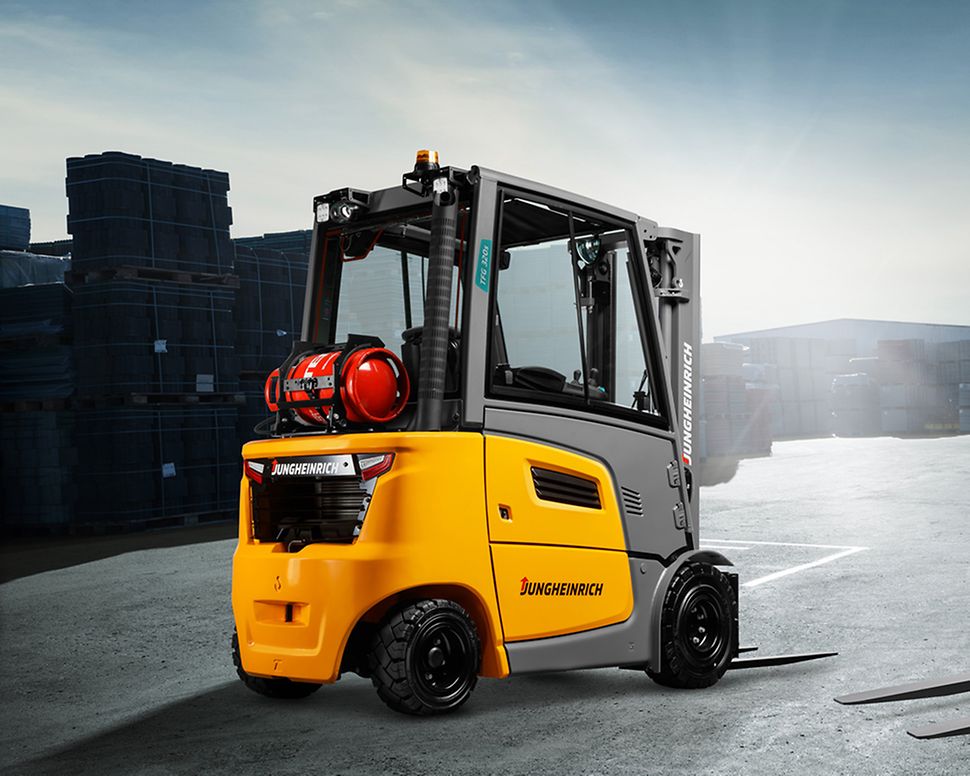
Gas Forklifts
Powerful and durable – gas forklift trucks by Jungheinrich
Jungheinrich gas forklifts not only optimise material handling in your warehouse and production area but also increase the efficiency of your warehouse. With a load capacity ranging between 1600kg and 5,000kg, these all-rounders can also handle large loads, even under the toughest operating conditions. This makes it possible to use gas forklift trucks indoors – unlike diesel forklifts, which require specific safety conditions.
Our gas forklift trucks are an ideal solution and are especially suited for outdoor application. These durable gas trucks are reliable even in the most extreme conditions such as wind, wet weather, dust, dirt or uneven surfaces. The uses for these versatile gas forklift trucks include the building materials industry, beverage industry, garden centres, agricultural industries, the timber industry and landfill sites.
Gas forklifts require gas bottle replacement regularly. The convenient handling for changing the gas bottle minimises downtime.
The gas forklift truck – the engine makes the difference
The success of the Jungheinrich gas forklift is the direct result of its powerful engine. With superior technical ingenuity, the vehicle achieves an incredibly high torque even at low speeds. This means that the gas forklift truck is a reliable solution for daily tasks in the warehouse and production facility. Innovative engine technology provides maximum efficiency. You can be rely on low emission values and fuel consumption with these economical gas forklifts. At the same time, gas forklifts run with a particularly low noise level, which makes a significant contribution to improving the working environment through lower noise pollution.
The gas forklift truck with gas drive
Gas forklift vehicles by Jungheinrich are also known as LPG forklifts, or LP gas forklifts, as well as propane- and butane-powered forklifts. Spare gas bottles can be carried directly on the forklift in a bottle cage or in permanently installed tanks that are fitted for bottles.
The gas forklift truck – the low-emission alternative to the diesel forklift truck
If forklift and transportation tasks primarily take place indoors at your company, you may be considering getting an emission-free electric forklift. Despite the efficiency of the low-consumption gas drive, a gas forklift truck still creates some emissions, which may create an odor indoors. However, in comparison with gas forklifts with an electric drive, gas forklifts score points due to their low price, versatility and powerful performance.
The higher noise level of gas forklifts is balanced out by their high power output. In addition, gas forklift trucks can handle ramp driving and transportation on unsurfaced ground and they are resistant to moisture and cold weather. This makes them ideal for transportation work between indoor and outdoor areas.
Powerful gas forklift trucks with different types of drive technology
Gas forklift trucks with a hydrostatic drive – fast, dynamic and precise
Our gas forklift trucks with a hydrostatic drive are ideal for reversing operation. They feature good handling performance, particularly for loading lorries. The great advantages of modern drive technologies are in the fast acceleration, precise steering and simple reversing. Gas forklifts also adapt effortlessly to various operational conditions. This is made possible by our five selected driving and working programmes, which are absolutely ideal for different deployment locations.
Gas forklift truck with hydrodynamic drive: the sturdy all-rounder
Our hydrodynamic forklift with a torque converter is ideally equipped for all transport tasks. Its strengths stand out even for medium and longer distances. The gentle, smooth start-up and optimal efficiency at medium and high speeds make it easier to handle goods in the warehouse and production facility. It does not require large amounts of energy in use. The powerful industrial engine ensures an exceptionally high torque even at low speeds.
Buy or lease gas forklift trucks
If you are searching for a high-performance gas forklift with economical energy values, our experts at Jungheinrich can steer you towards the gas forklift truck that best meets your operational needs. You can also rely on our specialist support for selecting features.
Our experts will also be happy to assist you with financing for your gas forklift trucks. Leasing or hire purchase of gas forklift trucks – which option suits your organisation best? We can work out a financial strategy together.
Are you interested in using gas forklift trucks on a temporary basis? You can rely on Jungheinrich for that, too. Our rental forklift consultants can give you attractive quotes that are customised to meet your operational challenges.